





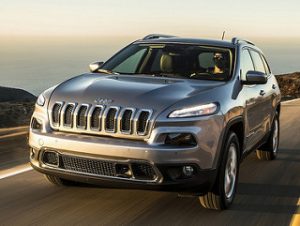
 Although both the 2016 Jeep Cherokee and 2016 Jeep Grand Cherokee are both trail-rated sport utility vehicles that are equally at home on a dirt track or on main street, there are some key differences that set apart these two stablemates. The Jeep Cherokee is a capable and attractive small crossover sport utility vehicle that can carry five passengers. The Jeep Grand Cherokee also has seating for five, but as it is a midsize SUV, it provides more room for both people and cargo. Powertrain equipment further differentiate these two Jeep models.
Powertrain
The Jeep Cherokee offers a 2.4-liter four-cylinder engine and an optional 3.2-liter V6. The Cherokee’s four-cylinder engine produces 184 horsepower and 171 pound-feet of torque. Stepping up to the more powerful V6 rewards buyers with 271 horsepower and 239 pound-feet of torque, giving the Cherokee more than ample acceleration. In contrast to the Cherokee’s optional V6 power, the Grand Cherokee boasts a 3.6-liter V6 engine with 295 horsepower as its standard power plant. For those who want more power, other engine options include a 5.7-liter V8, a 6.4-liter V8, and even a turbocharged 3.0-liter diesel that makes 420 pound-feet of torque.
Performance
Properly equipped, a 2016 Jeep Cherokee can hit 60 miles per hour from a stop in under eight seconds, a good showing for its competitive segment. While the trip to 60 takes under eight seconds for a Grand Cherokee as well, the Grand Cherokee is able to tow up to 7,400 pounds. This is a greater towing capacity than that of the Cherokee, which has an optional tow package with a towing capacity of 4,500 pounds. The Cherokee is able to achieve a combined fuel efficiency rating of 25 miles per gallon with its 2.4-liter motor, edging out the larger and comparatively thirstier Grand Cherokee.
Interior and Cargo Capacity
Although both can be had with a wide array of driver assistance technology, infotainment systems, and interior amenities, the Grand Cherokee does edge out its sibling with its luxury trim levels. That being the case, the cabin of the Cherokee is a nice place to spend some seat time on the way to adventure. The Cherokee is built on a smaller, lighter platform than the Grand Cherokee, but it still has 24.6 cubic feet of cargo space. The larger Grand Cherokee boasts 36.3 cubic feet of cargo space, making it just a bit more capable when it comes to packing in four friends and all the gear for a weekend camping trip.
Two- and Four-Wheel Drive Options
Although both can be had in four-wheel drive, the Cherokee comes standard with front wheel drive, while two-wheel drive examples of the Grand Cherokee are rear-wheel drive. When it comes to sending power to the wheel, these two vehicles do so with different engine options. The Cherokee’s lighter weight and smaller displacement engines allows it to be more efficient, whereas the larger Grand Cherokee, with its V6 and optional V8, produces more power and has the capability that comes with it.
Image by ASCOM Prefeitura de Votuporanga is licensed under CC BY 2.0
Connect with us
